How ChatGPT Creates Architectural Images
ChatGPT includes built-in image generation, the capability marketed as GPT-4o image generation when it launched, and now part of the standard chat experience. You can work with it in two main ways:
- Text-to-image. You describe a building, such as "a three-story brick townhouse with black steel windows at dusk," and it generates a picture.
- Image-to-image. You upload a sketch, a massing screenshot or a photo and ask it to restyle, complete or "render" it. This is how most architects try it, because it keeps the composition closer to their design.
What happens underneath is very different from a rendering engine. A tool such as V-Ray, Corona or Unreal Engine takes a 3D model and calculates how light behaves on its surfaces. ChatGPT predicts pixels that look like a plausible image matching your words and reference. There is no 3D scene, no measured geometry and no physical light. The result can be beautiful. It is not a calculation of your building.
If you do use it, prompts that name the camera height, lens, time of day, main materials and what must not change, then attach a screenshot of your own model, keep the output closer to the design. Even then, compare the result against the drawings before it leaves the office.

What Happens When You Give ChatGPT a Real Project
Rather than stage a one-off experiment, it is more useful to look at failure points that are consistent with how the technology works and with what architects report in public discussions on Reddit, in Facebook user groups and in AI-tool comparisons.
Scale and proportions drift. Floor-to-floor heights, window counts and the rhythm of a facade are treated as visual suggestions, not constraints. A five-bay facade can come back with six bays. A cantilever can grow.
Each image is a new interpretation. Ask for the street view and then the rear garden, and you get two buildings that are related rather than identical. Professional sets work the other way: every camera looks at the same model.
Materials become look-alikes. You can ask for "honed travertine" and get something warm and beige, but not the specified stone with its true color, veining and joint pattern.
Context is invented. Without a real site model, the neighbors, the trees, the slope and the view are imagined. For a marketing image, that may pass. For anything a buyer or a board relies on, it is a problem.
Small edits are not small. Asking it to change only the door color can alter the windows, the light or the landscaping at the same time, because the whole image is regenerated.
Text and fine detail are unreliable. Signage, railings, mullions and furniture details often break up under close inspection.
None of these is a flaw in a creative tool. They are the natural limits of generating an image from a description instead of rendering a model.
Where ChatGPT Is Genuinely Useful
Used for the right job, ChatGPT saves real time:
- Mood and direction. Exploring "Mediterranean modern" versus "warm minimalism" before anyone models anything.
- Concept options. Quick variations on massing, cladding or landscape ideas for internal discussion.
- Clarifying a brief. Turning vague client language into images everyone can react to, then handing those references to the visualization studio.
- Post-production ideas. Testing a sky, a season or an atmosphere before committing to it in the final render.
- Writing. Drafting design statements, captions and presentation text around the images.
In every case, the output is a reference, not a deliverable.
ChatGPT vs AI Rendering Tools vs a CGI Studio
| |
ChatGPT
|
AI rendering tools (Veras, mnml.ai, ReRender, MyArchitectAI)
|
Professional CGI (V-Ray, Corona, Unreal Engine)
|
|
Starting point
|
Text, sketch or image
|
Usually a screenshot or view from your model
|
Your plans and 3D model, built into a full scene
|
|
Control over geometry
|
Low
|
Medium; better when starting from a model view
|
Full
|
|
Consistency across views
|
Low
|
Improving, but not guaranteed
|
Full
|
|
Materials
|
Look-alikes
|
Style-driven
|
Specified and adjustable
|
|
Speed
|
Seconds
|
Seconds to minutes
|
Days
|
|
Best for
|
Ideas and mood
|
Fast design-stage visuals
|
Marketing, presales, approvals
|
Specialist AI rendering tools sit in the middle. Because many of them start from a view of your own model, they hold geometry better than a pure prompt. They still generate rather than calculate, so the same caution applies to anything public-facing.
Can You Use a ChatGPT Image for Marketing, Presales or Approvals?
Ask what the image is promising. A buyer who reserves a residence off-plan, an investor reviewing a pitch deck and a planning board judging a facade all treat the image as a representation of what will be built. If the window layout, the materials or the view are invented, the image is promising something the project may not deliver.
That does not mean AI images can never appear in a presentation. It means they should be clearly labeled as illustrative and never stand in for images derived from the drawings. Approvals are where this matters most, and we cover it in detail in why planning boards still reject AI-only visuals.
The risk is also practical. If the final building looks noticeably different from the image that sold it, the marketing problem shows up exactly when the developer can least afford it. That is the same reason camera choice matters, as we explain in how the wrong camera angle can ruin your design.
How Professional Studios Use AI Today
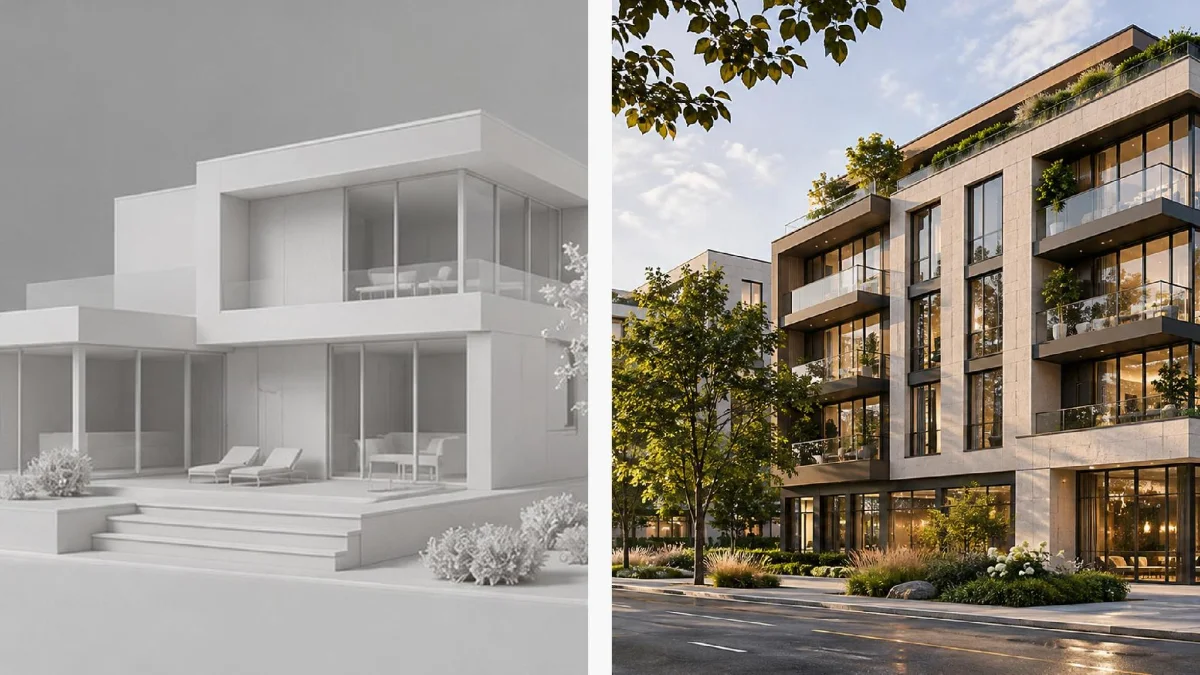
The real shift is not AI replacing rendering. It is AI becoming one more tool around a rendering pipeline that is still anchored in the model. At Ravelin3D, the pipeline remains the same for every project: a brief, the architectural files, agreed camera angles, a white clay model to confirm geometry, a preview with materials and light, rounds of comments, and final artwork at about 5,000 pixels.
That structure is what makes the result defensible. Geometry is checked before anyone talks about mood, and every view comes from the same scene. Whatever helps the team move faster has to fit inside that discipline, not replace it. For a sense of what fully modeled, photoreal work looks like, see our overview of photorealistic 3D rendering options for architectural projects, or explore our 3D visualization services.
FAQ
Can ChatGPT do 3D renderings?
Not in the technical sense. ChatGPT generates 2D images that can look like 3D renderings, but it does not build a 3D model or calculate light. It cannot export geometry, keep exact dimensions or produce several views of the same model the way a rendering engine does.
Is ChatGPT good for rendering images?
It is good for quick concept images, mood studies and restyling sketches. It is not reliable for images that must match drawings, specified materials or a real site. As of November 2026, its strength is speed and ideas, not accuracy.
Is ChatGPT good for architecture design?
It helps around the design process: brainstorming, research, writing briefs and design statements, and generating reference images. It does not replace design software, engineering, code review or the architect's judgment, and its outputs need checking before they are used in any formal deliverable.
What is the best AI for architectural rendering?
It depends on the job. General tools like ChatGPT and Midjourney suit open-ended ideas. Architecture-specific tools such as Veras, mnml.ai, ReRender and MyArchitectAI work from your model views and hold geometry better. For marketing and approvals, professional CGI built from the plans remains the standard.
Can AI render architecture plans?
AI tools can turn a plan or model screenshot into an attractive image, and some create 3D-looking views from floor plans. The results are interpretations, so dimensions, openings and materials may differ from the drawings. Treat them as previews and verify anything you plan to publish.
Will archviz be replaced by AI?
Not for work that has to be accurate. AI is speeding up concepting and parts of production, but marketing, presales and approvals still need images built from the actual design. The likely future is studios using AI inside a model-based pipeline, not instead of it.



 +1 (646) 693 0048
 main@ravelin3d.com